Those numbers come from the annual inflation adjustments the IRS announced on November 5, 2026, in Revenue Procedure 2026-35. This guide walks you through the 2027 standard deduction step by step: the amount for each filing status, the extra deductions for age and blindness, the special rule for dependents, how the deduction fits into the 2027 tax brackets, worked examples with real math, how to choose between the standard deduction and itemizing, and what it all means for your paycheck. Each section builds on the one before it, so you can read straight through or jump to the step you need.
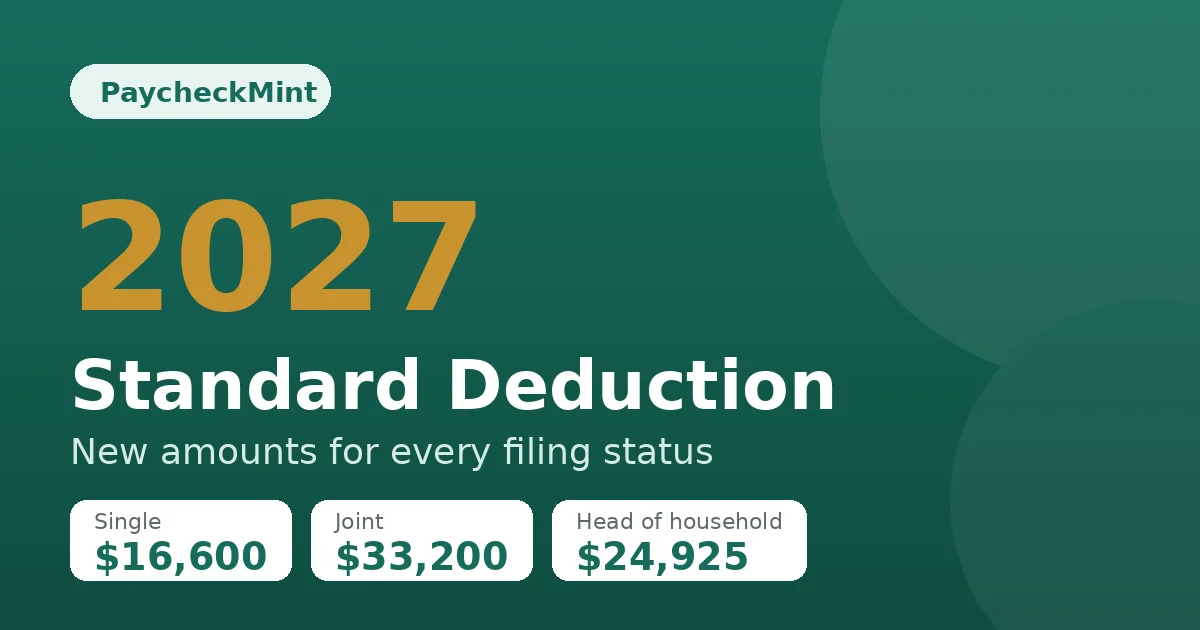
Quick Answer: 2027 Standard Deduction at a Glance
| Filing Status | 2027 Standard Deduction |
|---|---|
| Single | $16,600 |
| Married Filing Jointly | $33,200 |
| Married Filing Separately | $16,600 |
| Head of Household | $24,925 |
| Qualifying Surviving Spouse | $33,200 |
These amounts apply to income you earn in calendar year 2027 and report on the tax return you file in 2028. They do not change what you owe for 2026, which you will file in early 2027 using the 2026 amounts.
Key takeaways
- The 2027 standard deduction rises $500 for single and married-filing-separately filers, $775 for heads of household, and $1,000 for joint filers.
- The 2027 adjustments reflect a 3.2% inflation adjustment, larger than the previous two years, according to NerdWallet's analysis.
- Taxpayers 65 or older, or blind, add $1,700 per condition ($2,100 if unmarried).
- A dependent's standard deduction is limited to the greater of $1,400 or earned income plus $500.
- Most people use the standard deduction. Money.com reports that nearly 86% of taxpayers took it in 2026.
Step 1: Understand What the Standard Deduction Is
The standard deduction is a flat dollar amount the tax code lets you subtract from your adjusted gross income (AGI) before calculating tax. You do not need receipts, mileage logs, or a schedule of expenses. Whatever your filing status allows, you subtract.
Here is the basic flow of a federal return:
- Start with gross income (wages, interest, business income, and so on).
- Subtract certain adjustments, such as student loan interest or traditional IRA contributions, to reach adjusted gross income.
- Subtract either the standard deduction or your itemized deductions, whichever is larger and available to you.
- The result is taxable income, which is run through the tax brackets.
Because the deduction reduces taxable income, it works silently in the background. If you are single and your AGI is $70,000, the 2027 standard deduction means only $53,400 is subject to income tax. That $16,600 is effectively taxed at 0%.
Why the amount changes every year
The Tax Cuts and Jobs Act of 2017 roughly doubled the standard deduction and suspended personal exemptions. The 2025 law known as the One, Big, Beautiful Bill Act, which the IRS now promotes as the Working Families Tax Cuts, locked those changes in permanently. Each year the IRS adjusts the amounts for inflation using the chained consumer price index, so the deduction keeps pace with rising costs instead of shrinking in real terms.
Step 2: Check the 2027 Amounts for Your Filing Status
Here is the full comparison of 2026 and 2027 amounts, based on Rev. Proc. 2026-35 and the 2026 figures reported by Money.com and the IRS:
| Filing Status | 2026 | 2027 | Increase |
|---|---|---|---|
| Single | $16,100 | $16,600 | +$500 |
| Married Filing Jointly | $32,200 | $33,200 | +$1,000 |
| Married Filing Separately | $16,100 | $16,600 | +$500 |
| Head of Household | $24,150 | $24,925 | +$775 |
| Qualifying Surviving Spouse | $32,200 | $33,200 | +$1,000 |
Notice the pattern. The joint amount is exactly double the single amount, so a married couple filing together gets the same total deduction as two single people. Head of household sits in the middle, at roughly 1.5 times the single amount.
How much does the increase actually save you?
A higher deduction is not a dollar-for-dollar tax cut. It lowers taxable income, so your savings equal the increase multiplied by your top tax rate. ConsumerAffairs makes the same point: a $500 bump does not mean $500 off your tax bill.
| Filing Status | Increase | Savings at 12% | Savings at 22% | Savings at 24% |
|---|---|---|---|---|
| Single / MFS | $500 | $60 | $110 | $120 |
| Head of Household | $775 | $93 | $170.50 | $186 |
| Married Filing Jointly | $1,000 | $120 | $220 | $240 |
The real value of the inflation adjustment is that it prevents "bracket creep." Without it, a cost-of-living raise could push more of your income into higher brackets even though your purchasing power did not grow.
Step 3: Pick the Right Filing Status
Your standard deduction depends on the filing status you are entitled to on December 31, 2027. Choosing correctly matters, because the difference between single and head of household alone is $8,325 of deduction.
Single ($16,600)
You are single if you are unmarried or legally separated under a divorce or separate maintenance decree at the end of the year and do not qualify for another status. It is the default for unmarried taxpayers without dependents.
Married Filing Jointly ($33,200)
Available if you are married on the last day of the year. Both spouses report all income, deductions, and credits on one return. Joint filing usually gives the largest combined standard deduction, the widest tax brackets, and access to more credits, which is why most married couples choose it.
Married Filing Separately ($16,600)
Each spouse files their own return and claims their own deduction. This status can make sense in specific situations, such as when one spouse has large medical expenses, wants to keep liability separate, or is on an income-driven student loan repayment plan. It comes with a major trap, covered in Step 6: if one spouse itemizes, the other generally cannot take the standard deduction.
Head of Household ($24,925)
This status is for unmarried (or considered unmarried) taxpayers who paid more than half the cost of keeping up a home that was the main home of a qualifying person for more than half the year. A qualifying child is the most common example. Head of household also uses wider tax brackets than single, so the benefit goes beyond the larger deduction. The IRS can penalize preparers who are not diligent in checking head of household eligibility, and the 2027 penalty is $690 per failure, so expect questions if you claim it.
Qualifying Surviving Spouse ($33,200)
If your spouse died in 2025 or 2026 and you have a dependent child living with you, you may use the joint-return standard deduction and rate schedule for up to two years after the year of death, provided you have not remarried and you pay more than half the cost of the home.
Step 4: Add the Extra Deduction for Age 65+ and Blindness
If you are 65 or older, or blind, the tax code adds to your standard deduction. For 2027, the IRS set the additional amounts at:
- $1,700 for each condition if you are married or a surviving spouse
- $2,100 for each condition if you are unmarried and not a surviving spouse (single or head of household)
You count one condition for being 65 or older and one for being blind. A single person who is both over 65 and blind gets two additional amounts. For spouses, each person's age and blindness adds to the joint total.
| Situation (2027) | Calculation | Total Standard Deduction |
|---|---|---|
| Single, age 67 | $16,600 + $2,100 | $18,700 |
| Single, age 67 and blind | $16,600 + $2,100 + $2,100 | $20,800 |
| Head of household, age 66 | $24,925 + $2,100 | $27,025 |
| Married filing jointly, one spouse 65+ | $33,200 + $1,700 | $34,900 |
| Married filing jointly, both spouses 65+ | $33,200 + $1,700 + $1,700 | $36,600 |
| Married filing jointly, both 65+ and one blind | $33,200 + ($1,700 × 3) | $38,300 |
When do you count as 65?
The IRS treats you as 65 on the day before your 65th birthday. That means someone born on January 1, 1963, counts as 65 for the 2027 tax year, because the day before their birthday falls on December 31, 2027. In practice, if your 65th birthday is on or before January 1, 2028, you qualify for the additional amount on your 2027 return.
Step 5: Know the Special Rule for Dependents
If someone else can claim you as a dependent, such as a teenager with a summer job or a college student supported by parents, your standard deduction is limited. For 2027 it is the greater of:
- $1,400, or
- Your earned income plus $500 (but never more than the regular standard deduction for your filing status)
| Dependent's 2027 Earned Income | Calculation | Standard Deduction |
|---|---|---|
| $0 (interest only) | Greater of $1,400 or $500 | $1,400 |
| $900 | $900 + $500 = $1,400 | $1,400 |
| $3,000 | $3,000 + $500 | $3,500 |
| $8,000 | $8,000 + $500 | $8,500 |
| $17,000 | $17,500, capped at $16,600 | $16,600 |
Dependents who are 65 or older or blind also add the age or blindness amounts on top. The $1,400 figure serves a second purpose: it is the threshold used in the "kiddie tax" rules for a child's unearned income, per Rev. Proc. 2026-35. There are also no personal exemptions in 2027; the personal exemption stays at $0.
Step 6: Learn Who Cannot Use the Standard Deduction
Most taxpayers can use it, but a few situations force you to itemize or give up the deduction entirely:
- Married filing separately when your spouse itemizes. If one spouse itemizes, the other must itemize too, even if their itemized total is tiny. Always compare both returns before choosing this status.
- Nonresident aliens, with limited exceptions, generally cannot take the standard deduction.
- Dual-status aliens have limits for the year they change residency status.
- Short tax years. If you file for a period of less than 12 months because of a change in accounting period, you cannot use the standard deduction.
- Estates and trusts do not get the standard deduction.
If any of these may apply to you, talk with a tax professional before filing.
Step 7: Layer on the Extra Deductions Available Without Itemizing
Recent law adds several deductions that you can claim in addition to the standard deduction.
Senior deduction
Taxpayers age 65 or older can claim an additional deduction of up to $6,000 each for tax years 2025 through 2028. It begins to phase out at modified AGI above $75,000 ($150,000 for joint filers). The IRS noted in its 2027 announcement that its personal exemption figure does not include this senior deduction. This deduction is separate from the extra standard deduction in Step 4, so a 67-year-old single filer could qualify for both.
Tips and overtime deductions
Workers who receive qualified tips, or who earn qualified overtime pay, can deduct a portion of that income through 2028, subject to caps and income phaseouts. Because these are claimed outside of itemizing, they stack with the standard deduction. Check the IRS guidance each year for what counts as "qualified."
Charitable deduction for non-itemizers
Beginning in 2026, taxpayers who take the standard deduction can deduct limited cash gifts to qualifying charities, up to $1,000 for single filers and $2,000 for joint filers. This removes some of the old penalty for giving when you do not itemize.
Step 8: See How the Standard Deduction Fits Into the 2027 Tax Brackets
After the standard deduction, your taxable income is taxed in layers. Each rate applies only to the slice of income inside its bracket. Here are the official 2027 brackets from Rev. Proc. 2026-35.
Single filers
| Rate | Taxable Income |
|---|---|
| 10% | Up to $12,800 |
| 12% | $12,801 to $52,025 |
| 22% | $52,026 to $109,125 |
| 24% | $109,126 to $208,325 |
| 32% | $208,326 to $264,550 |
| 35% | $264,551 to $661,375 |
| 37% | Over $661,375 |
Married filing jointly
| Rate | Taxable Income |
|---|---|
| 10% | Up to $25,600 |
| 12% | $25,601 to $104,050 |
| 22% | $104,051 to $218,250 |
| 24% | $218,251 to $416,650 |
| 32% | $416,651 to $529,100 |
| 35% | $529,101 to $793,650 |
| 37% | Over $793,650 |
Head of household
| Rate | Taxable Income |
|---|---|
| 10% | Up to $18,250 |
| 12% | $18,251 to $69,650 |
| 22% | $69,651 to $109,100 |
| 24% | $109,101 to $208,300 |
| 32% | $208,301 to $264,550 |
| 35% | $264,551 to $661,350 |
| 37% | Over $661,350 |
Married filing separately
The brackets match the single brackets up to the 35% rate (ending at $264,550). The 37% rate begins at $396,825 for separate filers.
These brackets are applied to taxable income, not to your gross pay. That is why your standard deduction matters: it moves your starting point down before the brackets even begin.
Step 9: Work Through Real Examples
The examples below use the 2027 amounts and brackets. They are simplified (wages only, no credits) so you can follow the logic.
Example 1: Single employee earning $70,000
- AGI: $70,000
- Standard deduction: $16,600
- Taxable income: $70,000 − $16,600 = $53,400
- 10% of $12,800 = $1,280
- 12% of ($52,025 − $12,800 = $39,225) = $4,707
- 22% of ($53,400 − $52,025 = $1,375) = $302.50
- Total federal income tax: $6,289.50
With the 2026 deduction, this worker's deduction would be $500 smaller. At the 22% marginal rate, the 2027 increase saves about $110.
Example 2: Married couple filing jointly with $120,000 of wages
- AGI: $120,000
- Standard deduction: $33,200
- Taxable income: $86,800
- 10% of $25,600 = $2,560
- 12% of ($86,800 − $25,600 = $61,200) = $7,344
- Total federal income tax: $9,904
Because their taxable income stays below $104,050, everything above $25,600 is taxed at 12%.
Example 3: Head of household earning $60,000
- AGI: $60,000
- Standard deduction: $24,925
- Taxable income: $35,075
- 10% of $18,250 = $1,825
- 12% of ($35,075 − $18,250 = $16,825) = $2,019
- Total federal income tax: $3,844
A single filer with the same $60,000 income would have taxable income of $43,400 and owe about $4,952 before credits, roughly $1,100 more. That gap shows why head of household status is valuable when you qualify.
Example 4: Single retiree, age 67, with $50,000 of income
- AGI: $50,000
- Standard deduction: $16,600 + $2,100 (age 65+) = $18,700
- Taxable income before the senior deduction: $31,300
- If the retiree qualifies for the $6,000 senior deduction (modified AGI below $75,000): $31,300 − $6,000 = $25,300
- 10% of $12,800 = $1,280, plus 12% of $12,500 = $1,500
- Total federal income tax: $2,780
Without the senior deduction, the tax on $31,300 would be $3,500. The two senior-related breaks together reduce this retiree's taxable income by $8,100 compared with the basic standard deduction alone.
Example 5: A teenage dependent with a summer job
A 16-year-old earns $3,000 mowing lawns and working at a camp in 2027. Their standard deduction is $3,000 + $500 = $3,500, so their taxable income is zero. They may still need to file to get any withheld tax refunded.
Step 10: Decide Between the Standard Deduction and Itemizing
The rule is simple: use whichever is larger. Itemizing only wins when your qualifying expenses total more than your standard deduction. For 2027, here is the bar:
| Filing Status | Your itemized deductions must exceed |
|---|---|
| Single / Married Filing Separately | $16,600 |
| Head of Household | $24,925 |
| Married Filing Jointly | $33,200 |
Common itemized deductions to total up
- State and local taxes (SALT): state income or sales tax plus property tax, subject to the higher cap created by the 2025 law (about $40,000, scheduled to rise slightly each year, with a phase-down for high earners)
- Home mortgage interest on qualifying acquisition debt
- Charitable contributions to qualifying organizations
- Medical and dental expenses above 7.5% of AGI
- Casualty and theft losses from federally declared disasters
Example: Should this couple itemize?
A married couple has $14,000 in mortgage interest, $15,000 in state income and property taxes, and $4,000 in charitable gifts. Their itemized total is $33,000. The 2027 joint standard deduction is $33,200, so the standard deduction wins by $200. If they make another $1,000 of gifts, itemizing would win, so run the numbers again each year.
Bunching: a legitimate strategy
If you land just under the standard deduction every year, consider "bunching." You pay two years' worth of deductible expenses in one year, such as making two years of charitable gifts in December through a donor-advised fund, and then take the standard deduction in the off year. You itemize in the high year and use the standard deduction in the low year, capturing more total deductions across both.
One caution
You cannot change your mind casually. Once you file, switching between standard and itemized requires an amended return, and married-filing-separately spouses must make matching choices.
Step 11: Understand What It Means for Your Paycheck
Your employer's payroll system estimates your withholding using the standard deduction built into the tables, plus whatever you enter on Form W-4. When the IRS raises the deduction, withholding tables are updated, and your paycheck can edge up slightly.
Here is the rough math. A single employee in the 22% bracket benefits from a $500 larger deduction by about $110 per year. Spread over 26 biweekly paychecks, that is about $4.23 per paycheck. For a joint filer in the 22% bracket, the gain is about $220 a year, or around $8.46 per biweekly check. These are small amounts, which is what inflation indexing is meant to produce: it protects you from losing ground rather than handing you a windfall.
Want to see your own numbers? Try the PaycheckMint Paycheck Tax Calculator or the Take-Home Pay Calculator.
When to update your W-4
Revisit your Form W-4 if:
- You changed jobs or your spouse started or stopped working
- You had a child, adopted, or lost a dependent
- You plan to itemize in a year you normally take the standard deduction
- You claim large deductions, such as the senior deduction, and want your paycheck to reflect them
- You owed a large balance, or received a very large refund, last filing season
The IRS Tax Withholding Estimator is a free tool that does the math for you. Use it near the start of the year so adjustments spread across more paychecks.
Step 12: Review the Other 2027 Numbers That Pair With the Standard Deduction
The standard deduction is one piece of the 2027 inflation update. The IRS adjusted almost 70 tax provisions. These are the ones most closely tied to household budgets:
| Provision | 2027 Amount |
|---|---|
| Child Tax Credit (maximum per child) | $2,300 (up $100) |
| Refundable portion of Child Tax Credit | $1,800 (up $100) |
| Earned Income Tax Credit (3+ children, maximum) | $8,496 (up from $8,231) |
| Earned Income Tax Credit (no children, maximum) | $685 |
| Health FSA salary reduction limit | $3,500 (up $100) |
| Health FSA carryover | $700 (up $20) |
| Qualified transportation fringe (monthly) | $350 (up $10) |
| Annual gift tax exclusion | $20,000 (up from $19,000) |
| Estate tax basic exclusion | $15,480,000 |
| Alternative Minimum Tax exemption (single) | $93,000 |
| Alternative Minimum Tax exemption (joint) | $144,700 |
| Qualified business income deduction threshold (single) | $208,300 |
| Qualified business income deduction threshold (joint) | $416,600 |
| Adoption credit maximum | $18,250 |
| Foreign earned income exclusion | $137,300 |
If you use a health FSA or commuter benefits, these higher limits can lower your taxable pay further. For families, the larger Child Tax Credit often matters as much as the standard deduction.
Step 13: Avoid These Common Standard Deduction Mistakes
- Using the 2026 amounts for 2027 planning. The numbers on your return filed in early 2027 are the 2026 amounts. The 2027 amounts apply to the return you file in 2028.
- Forgetting the extra amount for age or blindness. This is one of the most frequently missed deductions among older filers. Check the box on your return and add the right amount for your status.
- Claiming head of household without qualifying. Having a child is not enough. You must have paid more than half the household costs, and the child must have lived with you more than half the year.
- Itemizing out of habit. If your itemized total falls below the standard deduction, you are paying more tax for extra paperwork. Re-run the comparison each year.
- Ignoring the married-filing-separately trap. If your spouse itemizes, you lose the standard deduction. A decision that looks harmless can cost thousands.
- Mixing up a deduction with a credit. A deduction reduces income. A credit reduces tax directly. A $1,000 deduction in the 22% bracket saves $220, while a $1,000 credit saves $1,000.
- Overlooking dependent limits. Parents sometimes assume a child can use the full standard deduction. As shown in Step 5, a dependent's deduction is capped by the earned-income rule.
Step 14: Use This Planning Checklist for 2027
- Confirm your 2027 filing status. Marriage, divorce, a new child, or a death in the family changes your status as of December 31.
- Write down your standard deduction. Use the table in Step 2, then add any age or blindness amounts from Step 4.
- Estimate your itemized deductions. Add up mortgage interest, SALT, charitable gifts, and medical costs. Compare to your standard deduction.
- Consider bunching if you are within a few thousand dollars of the standard deduction.
- Check the stackable deductions (senior, tips, overtime, charitable) for which you may qualify.
- Run the IRS Tax Withholding Estimator and update your W-4 if your situation changed.
- Keep records anyway. If you itemize, or if the IRS asks about head of household or dependent status, documentation matters.
- Watch for legislation. Rev. Proc. 2026-35 reflects the tax code as it stands today. If Congress changes the law for 2027, the IRS will issue new guidance.
Frequently Asked Questions
What is the standard deduction for 2027?
It is $16,600 for single filers and married individuals filing separately, $24,925 for heads of household, and $33,200 for married couples filing jointly and qualifying surviving spouses.
When do the 2027 standard deduction amounts apply?
They apply to income earned in 2027, which you report on the return you file in 2028. For the return you file in early 2027, use the 2026 amounts.
How much did the standard deduction go up for 2027?
Single and married-filing-separately filers gain $500, heads of household gain $775, and joint filers gain $1,000, compared with 2026.
Is the additional standard deduction for seniors different from the senior deduction?
Yes. The additional standard deduction ($1,700, or $2,100 if unmarried) is part of the regular standard deduction rules. The separate senior deduction of up to $6,000 is a newer provision available for 2025 through 2028, subject to income limits. Eligible seniors can potentially claim both.
Can I take the standard deduction and still claim the Child Tax Credit?
Yes. The Child Tax Credit is a credit, not a deduction, and it does not depend on whether you itemize. For 2027 it is up to $2,300 per qualifying child, with up to $1,800 refundable.
Can I take the standard deduction if I'm a dependent?
Yes, but it is limited to the greater of $1,400 or your earned income plus $500, up to the regular amount for your filing status.
Should I itemize if my deductions are close to the standard deduction?
Only if your itemized total is larger. If they are close, the standard deduction is simpler and carries less audit exposure. Consider bunching expenses into alternating years if you want to capture more value.
Does the standard deduction reduce self-employment tax?
No. The standard deduction lowers income tax only. Self-employment tax is calculated on net self-employment earnings before the standard deduction is applied.
Do I need to file a return if my income is below the standard deduction?
Often, no, but there are exceptions. You may still want to file to claim a refund of withheld tax or refundable credits such as the Earned Income Tax Credit.
Will the standard deduction go up again in 2028?
The IRS adjusts it annually for inflation, so it will likely increase again, but the amount depends on inflation measured over the following year. The IRS typically announces next year's figures in the fall.
Conclusion: What to Do With the 2027 Standard Deduction Numbers
The 2027 standard deduction is $16,600 for single and married-filing-separately filers, $24,925 for heads of household, and $33,200 for joint filers and qualifying surviving spouses. Add $1,700 per age or blindness condition if you are married ($2,100 if you are not), keep the dependent formula in mind for teens and students, and remember that the deduction shrinks your taxable income rather than your tax bill directly.
For most households, the takeaway is straightforward. Take the standard deduction unless your itemized expenses clearly beat it, check whether extra deductions such as the senior deduction apply, and review your W-4 once your 2027 picture is clear.
Estimate your take-home pay
See how deductions, taxes and pay frequency change your paycheck.
Calculate my paycheckSources
- IRS, IRS releases tax inflation adjustments for tax year 2027, IR-2026-133 (November 5, 2026)
- IRS, Revenue Procedure 2026-35
- NerdWallet, IRS Announces 2027 Income Tax Brackets, Updated Standard Deduction
- Money.com, Here Are the New Federal Income Tax Brackets for 2027
- ConsumerAffairs, IRS announces higher tax brackets and deductions for 2027
Disclaimer: This article is for general educational purposes and is not tax, legal, or financial advice. Tax rules can change and individual situations vary. Consult a qualified tax professional or the IRS before making decisions based on this information.