SAVE Plan Is Over: What the Nov 18 Court Ruling Means for You
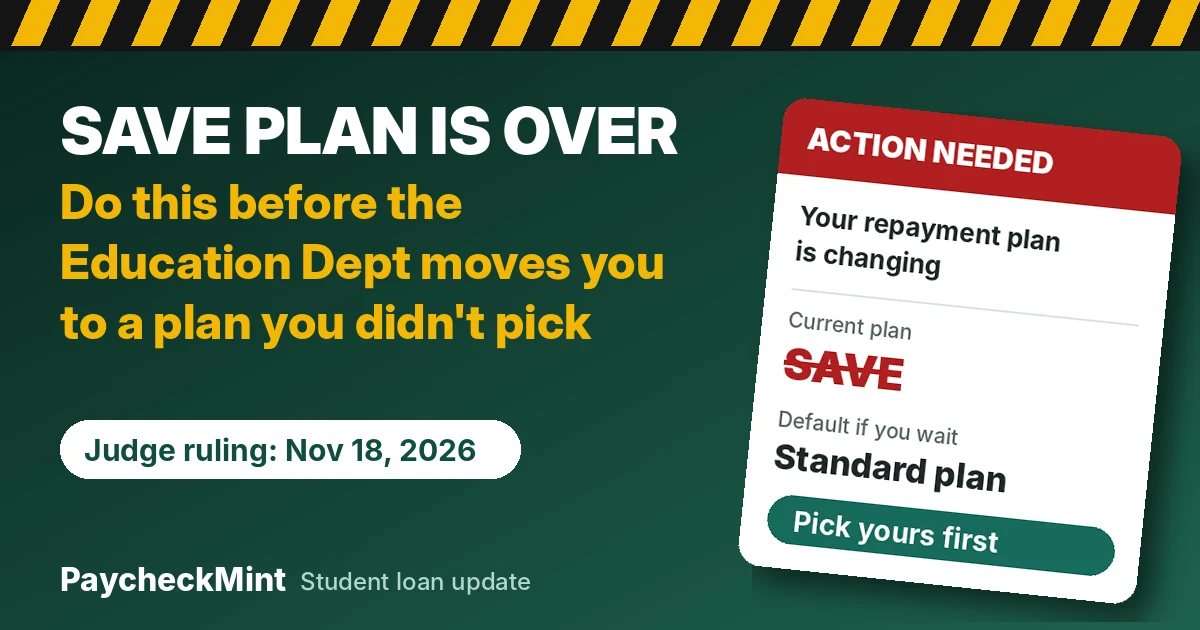
Quick answer: The SAVE plan has ended, and on November 18, 2026 a federal judge refused to stop the Education Department from moving borrowers off it. If you were on SAVE, the department says you must choose a new repayment plan or you will be placed on the Standard plan. Choose your own plan on studentaid.gov before a default is chosen for you.
If you spent the last two years in SAVE forbearance, you probably stopped checking the news. That was understandable, because the story kept changing. It has now settled enough to act on. The lawsuits from Republican-led states did their job, a federal appeals court closed the plan, and a new court ruling this week removed one of the last hopes of a quick rescue.
Below is a plain-language look at what the ruling does and does not mean, what the 30-day rule is, and the steps that protect your monthly budget. If you are also watching your paycheck, see how loan payments fit into gross pay vs. net pay.
What changed this week?
The headline is simple. The November 18 decision in the Havens case denied a request to freeze the transfers. It was not a final ruling, and the court said a separate decision on dismissing the case is still to come. The short version: the department can keep going, and borrowers who wait are betting on a different outcome.
1. SAVE is ended, not paused
For more than a year, SAVE borrowers sat in administrative forbearance while Republican-led states fought the plan in court. Reporting puts the number at over 7 million people. That pause was never meant to be permanent, and a March 2026 order from the Eighth Circuit Court of Appeals closed the door on the program itself.
The Education Department now says it plainly: a court order ended SAVE, so you must choose a different plan.
Where to look: Open your account at studentaid.gov and check which plan and servicer are listed. Stop assuming that forbearance means you can wait.
2. The November 18 ruling went against borrowers
A separate case, Havens v. U.S. Department of Education, was filed in federal court in Washington, D.C. by a small group of borrowers. They argued that once SAVE fell, they should slide back to REPAYE, the plan SAVE replaced. On November 18, 2026, Judge Loren Alikhan declined to issue the emergency order they wanted.
In practice, that means the department is free to keep moving former SAVE borrowers while the lawsuit continues. The judge also left two big questions open: whether the case gets dismissed, and whether REPAYE legally came back at all.
What to do: Treat the ruling as a signal to act, not as a reason to wait for a court rescue. If the plaintiffs win later, you can adjust again.
3. The 30-day clock
The department's message to SAVE borrowers is blunt. Apply for another plan within 30 days, or you will be placed on the Standard Repayment Plan. Some borrowers have already reported hitting the end of a 30-day extension.
The clock matters because Standard is not a neutral parking spot. It is a fixed payment schedule, not one that moves with your income.
What to do: Read every message from your servicer, including the ones that look routine. Note the date on any notice that mentions a 30-day window.
4. There is still no single transfer date
Here is the confusing part. A court filing on November 10 asked the department for a timeline, and a later report on a related filing says there is no specific one for pushing borrowers out of SAVE. Many borrowers say they have not been told when their own move will happen.
No announced date does not mean no date. It means your notice could arrive with little warning.
What to do: Check your servicer account and the email tied to it this week. Make sure your contact details are current, so a notice does not go to an old address.
5. The default plan can cost you more
A plan that adjusts to your income can keep payments low when money is tight. Standard works the other way: the amount is set by your balance and repayment length. For a borrower who paid little or nothing during forbearance, the first Standard bill can feel like a jump.
Income-Based Repayment (IBR) is one income-driven option you can apply for. Your servicer and studentaid.gov show every plan you currently qualify for.
What to do: Use the Loan Simulator on studentaid.gov to compare monthly payments under each plan before you choose. Then plan around the number, not the plan name.
6. Forgiveness may come with a tax bill
The Havens ruling highlights a tax catch. Two plaintiffs who reached forgiveness eligibility before 2026 would still owe tax on a 2026 discharge, because they had not applied to switch plans by December 31, 2025. The details depend on your plan, your loans and your tax situation.
If you are near forgiveness, the plan you choose now can affect when and how much is forgiven.
What to do: Ask a tax professional or a student loan attorney before you commit to a plan, especially if forgiveness is within a few years.
7. Paper trail and PSLF
Plan changes sometimes go wrong, and the fix usually depends on proof. Save screenshots of your application, confirmation emails and the plan listed on your account after each change. If you are working toward Public Service Loan Forgiveness, confirm your payments are still counting under the new plan.
The SAVE lawsuits were not about PSLF, but a plan switch can still affect how your payments are recorded.
What to do: Keep a folder with dates, confirmation numbers and the name of anyone you spoke to at your servicer.
Where each court fight stands
| Case | Who is involved | Where it stands |
|---|---|---|
| Challenge to the SAVE plan | Missouri, Kansas and other Republican-led states | Over. The Eighth Circuit order in March 2026 ended the program. |
| Havens v. Department of Education | Borrowers who want REPAYE restored | Injunction denied on November 18, 2026. A ruling on dismissal is still pending. |
| Education Department transfers | Millions of former SAVE borrowers | Continuing. No single public timeline. |
Your 5-step plan before a default is chosen
- Log in to studentaid.gov and write down your servicer, balance and current plan.
- Find any notice from your servicer and mark the date of any 30-day window.
- Run the Loan Simulator and compare the payment under each plan you qualify for.
- Apply for the plan you pick and save the confirmation.
- Add the new payment to your budget before the first bill arrives.
See what is left after your loan payment
Enter your pay, filing status, state and deductions to estimate your take-home pay, then subtract your new student loan payment.
Open the take-home pay calculatorFrequently asked questions
Is the SAVE plan still available?
No. A court order ended the SAVE plan, and the Education Department tells borrowers they must choose a different repayment plan. New enrollment is closed.
What happens if I do not pick a new plan?
The Education Department says SAVE borrowers who do not apply for another plan within 30 days will be placed on the Standard Repayment Plan. Standard payments are fixed rather than tied to income, so the bill can be much higher than you expect.
Did the November 18 ruling bring back REPAYE?
No. A federal judge denied a request for an injunction that would have stopped the transfers. The judge did not decide whether REPAYE legally returned when SAVE ended, and the case is still open.
Is there a deadline for leaving SAVE?
The department has not published a single date. A recent court filing says there is no specific timeline for moving borrowers out of SAVE, so your servicer notice is the deadline that counts for you.
Could my loan forgiveness be taxed?
It can be. Reporting on the Havens case notes that two plaintiffs who reached forgiveness eligibility before 2026 would still owe tax on a 2026 discharge, because they did not apply to switch plans by December 31, 2025. A tax professional can tell you how this applies to you.
Does this affect Public Service Loan Forgiveness?
The SAVE lawsuits were about the SAVE plan, not PSLF. If you are working toward PSLF, confirm with your servicer which plan you are on and that your payments are being counted.
This article is for general information only and is not legal, tax or financial advice. Court cases and Education Department policies change quickly. For advice about your situation, talk to your loan servicer, a student loan attorney or a qualified tax professional.