Why Is My Paycheck Smaller Than Expected? 10 Common Reasons
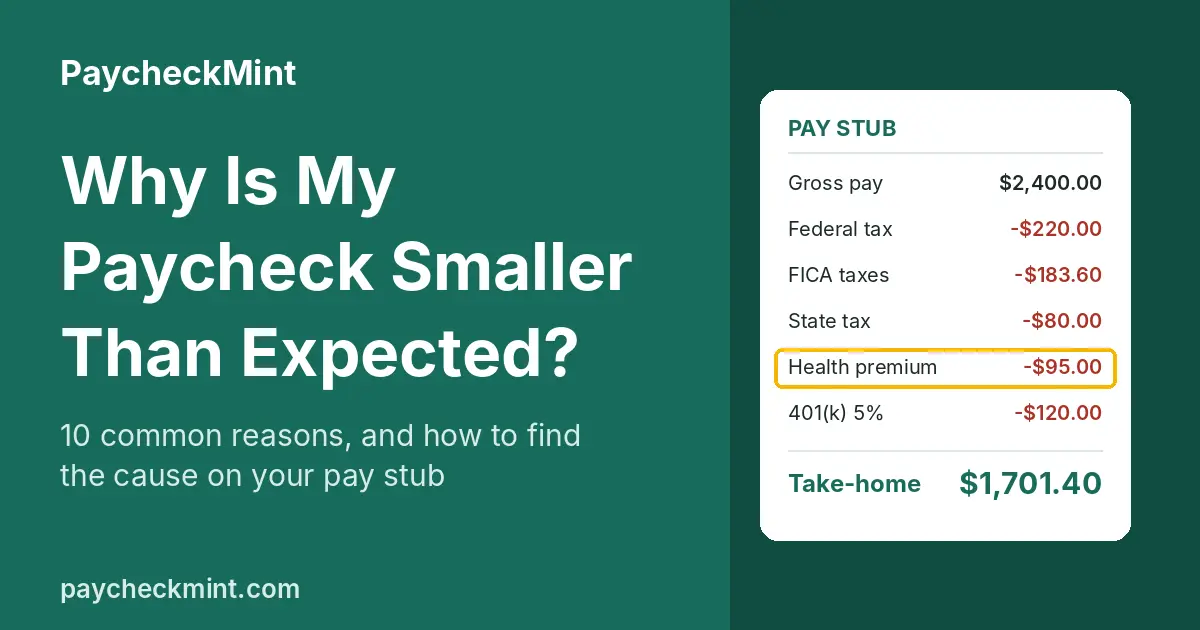
Quick answer: A paycheck usually shrinks because of something that changed on the deduction side (benefits, retirement, withholding, garnishments, taxes) or the earnings side (hours, overtime, bonus timing). Put this pay stub next to your last one and compare gross pay, each tax line and each deduction. The difference is almost always visible.
If your paycheck is smaller than expected, you are not alone, and it is rarely random. You do the math before payday, expect a certain number, and the deposit lands lower. The cause is usually something you can identify on your pay stub in a few minutes, whether you are asking why your paycheck is lower this month, less than last time, or less than your hourly rate times hours.
Is it normal for a paycheck to go down?
Yes. Gross pay can stay the same while take-home pay falls, because take-home pay is what remains after taxes and deductions. Changes to any of those, even small ones, add up. A $30 higher premium and a 2-point higher 401(k) rate can take roughly $80 off a $2,400 biweekly check.
Below are the 10 most common reasons, what each one looks like on a pay stub, and what you can do about it. If you want to see how gross pay turns into net pay first, start with gross pay vs. net pay and what take-home pay is.
2. A changed W-4 or withholding setup
Your Form W-4 tells your employer how much federal income tax to withhold. A new W-4 can change your check quickly: a different filing status, fewer or no dependents claimed, extra withholding added, or a second job entered. Some people also file a new form after a life change and forget about it. Payroll systems and IRS withholding tables are also updated for each tax year, which can shift withholding even if you changed nothing.
Where to look: The federal income tax withholding line, plus any "additional withholding" line.
What to do: Review your current W-4 with your employer or in your payroll portal. Withholding that is too high means a smaller check now and a bigger refund later. Too low can mean owing at tax time. Try the paycheck tax calculator to see how different inputs change your estimate.
3. Fewer paid hours
This one is easy to miss if you are paid hourly or have variable hours. Unpaid time off, a shorter schedule, a holiday week, unpaid leave, a late timesheet or a new hire starting mid-period can all lower gross pay. If you are salaried but started or ended employment mid-period, the first or last check may also be prorated.
Where to look: Hours worked and gross pay at the top of your pay stub.
What to do: Compare hours to your own timesheet. For hourly work, the hourly paycheck calculator shows what a given number of hours should produce. If you are paid every two weeks, the biweekly paycheck calculator can help you sanity check the amount.
4. A higher retirement contribution
Some employers automatically raise your 401(k) contribution rate each year (called auto-escalation). Or you may have increased it yourself and forgotten. Either way, a bigger contribution means a smaller deposit, though the money is going into your own account.
Keep in mind that traditional 401(k) contributions lower your income tax withholding but still count for Social Security and Medicare tax. Roth contributions are taken after tax, so they reduce take-home pay by the full amount.
Where to look: The retirement or 401(k) line in deductions, shown as a dollar amount or percentage.
What to do: If you want a bigger check, you can lower the rate, but check first whether you would give up an employer match. See our 401(k) guide for how contributions and matches work.
5. Bonus and supplemental pay withholding
If a bonus, commission or back pay arrived smaller than you expected, the culprit is usually withholding. Bonuses are treated as supplemental wages, and many employers withhold federal income tax at a flat rate, commonly 22% for amounts under $1 million. Social Security, Medicare and state tax are withheld on top of that.
That withholding is an estimate. If it is more than your real tax rate, the difference comes back to you when you file your return. Your bonus is not "taxed at a higher rate" in the final tally.
Where to look: A separate earnings line for bonus or commission, and the federal tax withholding for that check.
6. Overtime that did not feel like it paid off
Overtime is taxed at the same rates as other income, but your paycheck is withheld as if the larger amount continued for the whole year. That can push the estimate of your tax higher for that period, so an overtime check looks like it lost a bigger slice than usual. Some of that may be returned as a refund. Also confirm the overtime was calculated at the right rate (often one and a half times your regular rate, depending on your state and job).
What to do: Use the overtime pay calculator to check the gross amount, then compare to the paycheck.
7. The new-year payroll tax reset
Social Security tax applies only up to a yearly wage cap. Higher earners hit that cap late in the year and then see Social Security tax stop, which makes later paychecks larger. In January the count restarts, so Social Security tax returns and take-home pay drops. Medicare tax has no cap, and an additional 0.9% Medicare tax is withheld on wages above $200,000.
The standard employee share is 6.2% for Social Security plus 1.45% for Medicare, 7.65% together, on most wages.
What to do: If your first paychecks of a new year are smaller, compare the FICA lines to late-December stubs. This is normal, and you can plan for it in your paycheck budget.
8. Wage garnishments or levies
A garnishment is an amount your employer is legally required to take from your pay for a debt, such as child support, defaulted student loans, unpaid taxes or a court judgment. Federal law limits how much can be taken for most ordinary debts, and child support and tax levies follow different rules. You will typically receive a notice, but if you missed it, the deduction can look like a surprise.
Where to look: A line labeled garnishment, levy, child support or a similar name.
What to do: Ask payroll which order the deduction is for, and contact the agency or creditor that issued it. If you think it is wrong, an attorney or a legal aid group can advise you on options.
9. State and local tax changes
Moving, changing where you work, or working remotely across state lines can change your state and local withholding. Some states also withhold for programs like disability insurance or paid family leave, and some cities or school districts add local taxes. Rates and wage bases for these programs are updated periodically.
Where to look: State income tax, SDI/PFL and local tax lines.
What to do: Make sure your employer has your correct home and work address and has the right state withholding form on file. Our state paycheck calculators, such as the California paycheck calculator, show how state rules change take-home pay.
10. Pay period timing or a payroll error
Sometimes nothing changed in your pay, but the timing did. Pay dates can shift around holidays, a pay period can cover fewer working days, or some employers pay in arrears so a check reflects earlier hours. Biweekly workers also get two months each year with three paychecks, which makes other months feel lighter by comparison.
Payroll mistakes also happen: a missed raise, a wrong pay rate, a duplicated deduction or an unapplied correction from an earlier period.
What to do: Check the pay period dates and pay date on the stub. If something looks wrong, contact payroll or HR with the specific line, the amount you expected and why, and ask for a written correction.
Example: how $2,400 of gross pay becomes $1,701.40
Here is a simplified biweekly example. Real numbers depend on your filing status, state, pre-tax benefits and employer. It is for illustration only.
| Line | Amount |
|---|---|
| Gross pay | $2,400.00 |
| Federal income tax withholding | -$220.00 |
| Social Security (6.2%) and Medicare (1.45%) | -$183.60 |
| State income tax | -$80.00 |
| Health insurance premium | -$95.00 |
| 401(k) at 5% | -$120.00 |
| Take-home pay | $1,701.40 |
If the premium rose by $30 and the 401(k) rate went from 5% to 7%, the same gross pay would produce about $1,623 instead, roughly $78 less, with no change in salary.
Why is my paycheck lower this month? Quick reference
| If this changed | Look at this line | Typical effect |
|---|---|---|
| Health plan or premiums | Medical, dental, vision deductions | Smaller check, same gross pay |
| W-4 or filing status | Federal income tax withholding | Lower or higher withholding |
| Hours or schedule | Hours and gross pay | Lower gross pay |
| 401(k) rate | Retirement deduction | Smaller check, higher savings |
| Bonus or commission | Supplemental earnings and tax | Looks heavily taxed, reconciled at filing |
| New year | Social Security and Medicare | More payroll tax early in the year |
| Legal orders | Garnishment or levy | Fixed or percentage deduction |
| Moved or changed work location | State and local tax | Different state or local withholding |
How to find the cause in 5 steps
- Pull up the last two pay stubs and put them side by side.
- Compare gross pay first. If it is lower, the cause is hours, rate or timing.
- If gross pay is the same, compare taxes (federal, Social Security, Medicare, state, local).
- Then compare deductions (benefits, retirement, garnishments, other).
- Plug your numbers into a calculator to see what the check should look like, and ask payroll about any line you cannot explain.
Check your numbers
Enter your pay, filing status, state and deductions to see an estimate of your take-home pay.
Open the take-home pay calculatorFrequently asked questions
Why is my paycheck suddenly lower with no changes?
Common causes are higher benefit premiums after open enrollment, a new year's payroll tax reset, fewer paid hours, a change in retirement contribution rate, or a new garnishment. Compare this pay stub to your last one, line by line, to find the difference.
Why is my bonus taxed so much?
Bonuses are supplemental wages. Many employers withhold federal income tax at a flat rate, commonly 22% for amounts under $1 million, plus Social Security, Medicare and any state tax. That withholding is an estimate, and your actual tax is settled when you file your return.
Does overtime get taxed at a higher rate?
No. Overtime is taxed at the same rates as other income. A larger paycheck can have more withheld because payroll estimates tax as if that pay level continued all year, but any over-withholding is reconciled when you file.
Why is my paycheck smaller this year than last year?
Year-over-year drops usually come from higher benefit premiums, a higher 401(k) contribution rate, updated withholding tables or a changed W-4, new state or local programs, or a new garnishment. A raise can also be offset by these changes. Compare a pay stub from each year line by line.
Why is my paycheck less than my hourly rate times hours worked?
Your hourly rate times hours gives gross pay. Your paycheck is net pay, which is lower after federal, Social Security, Medicare and state taxes plus benefit and retirement deductions. Use a paycheck calculator to estimate the difference.
What should I do if I think my paycheck is wrong?
Compare your pay stub with your last one, check hours and deductions, and contact your payroll or HR department with the specific line that looks off. Ask for a correction in writing if there is an error.
This article is for general information only and is not tax, legal or financial advice. Withholding rules, rates and wage limits vary by employer, state and year. For advice about your situation, talk to your payroll department or a qualified tax professional.