Before Your First 2027 Paycheck Hits: 4 Payroll Settings Silently Costing You Thousands
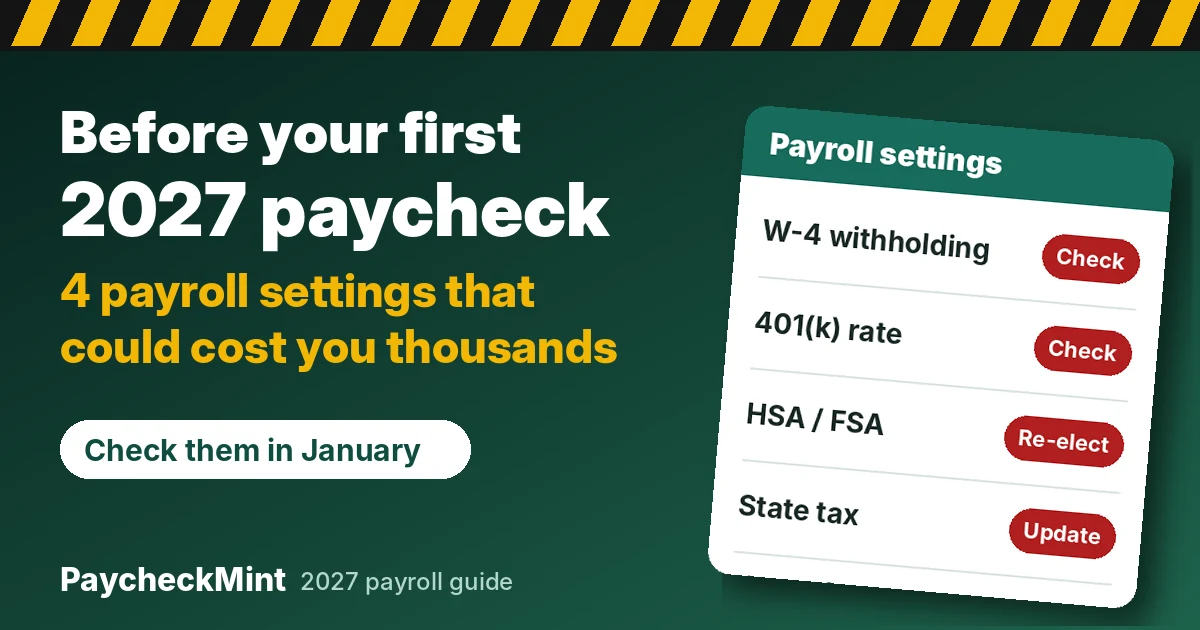
Quick answer: Four payroll settings can quietly cost you money in 2027: an out-of-date W-4, a 401(k) rate below your employer match, HSA or FSA elections that were never renewed or resized, and state or local withholding that does not match where you live and work. Check each one against your last pay stub before the first January paycheck.
Payroll has a habit of repeating whatever you told it last time. That is convenient until the year turns over and the rules do not. The IRS has already published its 2027 limits, Social Security has a higher wage cap, and your employer is about to run a brand-new year of paychecks from settings that may be years old.
None of the four fixes below takes long. Each one comes with the 2027 number to know and an example that shows what it can cost. If you want the basics first, read gross pay vs. net pay.
The 2027 numbers that change on January 1
| Item | 2026 | 2027 |
|---|---|---|
| Social Security wage base | $184,500 | $192,300 |
| 401(k) employee limit | $24,500 | $25,500 |
| 401(k) catch-up (age 50+) | $8,000 | $8,500 |
| HSA limit, self-only | $4,400 | $4,500 |
| HSA limit, family | $8,750 | $9,000 |
| Health FSA limit | $3,400 | $3,500 |
| Standard deduction, single | $16,100 | $16,600 |
| Standard deduction, married filing jointly | $32,200 | $33,200 |
High earner note: The most an employee can pay in Social Security tax rises from $11,439 to $11,922.60 in 2027. Medicare tax has no cap, and an extra 0.9% applies to wages above $200,000.
1. Your W-4 is still set for a different year
Nothing forces you to update your Form W-4. Payroll keeps using whatever is on file, even a form from several years ago, so a stale one can quietly over-withhold or under-withhold for years. The 2026 form also added lines on the Deductions Worksheet for expected tips and overtime, and the 2027 draft keeps them.
Those lines matter because employers generally cannot lower your withholding for the overtime deduction unless you hand in an updated W-4 that accounts for it. The deductions themselves (up to $12,500 for overtime and $25,000 for tips) are claimed on your tax return, so the W-4 only decides when you get the benefit: in each paycheck or as a refund.
A simple example. If your W-4 withholds an extra $100 every two weeks without a reason, that is $2,600 a year handed to the IRS as an interest-free loan. If it withholds too little, you may owe at filing. Also note that if you claimed exempt status for 2026, you must turn in a new W-4 by February 16, 2027 to keep it.
What to do: Open the IRS Tax Withholding Estimator, enter your latest pay stub and see whether it recommends a change. If it does, it will help you fill out a new W-4 to give to payroll.
2. Your 401(k) rate leaves match money behind
A set-and-forget contribution rate is easy to ignore. It is also where the biggest silent leaks tend to hide. Say you earn $80,000 and your employer matches 100% of the first 4% you contribute. Contributing 2% puts in $1,600, and the match adds another $1,600. At 4% you would get $3,200 in match instead, so the gap is $1,600 a year in free money.
Two other traps. First, a fixed dollar election does not grow when your raise lands, but a percentage does. Second, if you front-load so heavily that you hit the annual limit before December, some plans stop the match for the remaining paychecks unless they offer a true-up. Ask HR which kind of plan you have.
The 2027 employee limit is $25,500, up $1,000. Workers 50 and older can add a catch-up of up to $8,500 in most plans.
What to do: Find your contribution line on your pay stub, compare it to your plan's match formula and confirm whether the plan trues up the match at year-end.
3. Your HSA and FSA elections lapsed or never grew
Health account limits rise in 2027, but your payroll deduction does not move on its own. The HSA limit is $4,500 for self-only coverage and $9,000 for family coverage, and anyone 55 or older can add $1,000. Employer contributions count toward the same limit, so add them in before you set your amount.
Health FSAs work differently. Many plans require you to choose a new amount every open enrollment, and if you skip it you may start January with nothing set up. The 2027 FSA limit is $3,500, and plans that allow a carryover can let you keep up to $700.
Payroll-deducted contributions usually avoid federal income tax and often Social Security and Medicare tax too. At a 22% federal bracket plus 7.65% payroll tax, a $4,500 HSA contribution could save roughly $1,330 compared with paying the same costs from after-tax pay, before any state savings. That is an illustration, not a promise; your own rates will differ.
What to do: Log in to your benefits portal, confirm that your 2027 HSA or FSA election exists, and size it to your expected medical spending, not last year's habit.
4. Your state and local withholding does not match where you live and work
Moves, new jobs and remote work are the usual triggers. Payroll withholds state and local tax based on the addresses and forms on file. If your home address, work location or state form is out of date, the wrong state can be taxed, local tax can be missed, and you may face a surprise bill when you file.
The fix is rarely complicated, but it is easy to forget because the numbers look normal on each paycheck. States vary a lot in how they treat remote workers and people who live in one state and work in another, so check your own state's rules.
What to do: Confirm your home address and work location in the payroll system. Look at the state and local tax lines on your last stub and ask payroll if anything looks like it belongs to the wrong place.
Your 10-minute payroll audit
- Grab your latest pay stub and note gross pay, each tax line and every deduction.
- Run the IRS Tax Withholding Estimator and update your W-4 if it suggests a change.
- Compare your 401(k) rate with your employer's match formula and any year-end true-up.
- Confirm your HSA or FSA election exists for 2027 and fits your expected costs.
- Check your state and local lines against your home address and work location.
See what your 2027 paycheck will look like
Enter your pay, filing status, state and deductions to estimate your take-home pay after these changes.
Open the take-home pay calculatorFrequently asked questions
Do I have to submit a new W-4 for 2027?
Usually not. Employers keep withholding from the Form W-4 already on file, even an old one. The exception is exempt status: if you claimed exempt for 2026, you need to submit a new W-4 by February 16, 2027 to keep it. Updating is still smart if your pay, household or job situation changed.
What is the 401(k) contribution limit for 2027?
$25,500 for employee deferrals, up $1,000 from $24,500 in 2026. The catch-up amount for workers age 50 and older rises to $8,500 in most plans, up from $8,000.
What are the 2027 HSA limits?
$4,500 for self-only coverage and $9,000 for family coverage, up from $4,400 and $8,750. People age 55 and older can add $1,000. You must be covered by a qualifying high-deductible health plan to contribute.
What is the 2027 health FSA limit?
$3,500 for plan years beginning in 2027, up $100. If your plan allows a carryover, the maximum is $700. Each spouse with their own health FSA has a separate limit.
What is the Social Security wage base for 2027?
$192,300, up from $184,500. Employees pay 6.2% up to that amount, so the most an employee can pay in 2027 is $11,922.60. Medicare tax has no wage cap.
Why might my first January paycheck be smaller?
If your 2026 earnings went above the Social Security wage base, Social Security tax stopped late in the year and restarts in January. New benefit elections, a higher 401(k) rate or a changed W-4 can also lower take-home pay.
This article is for general information only and is not tax, legal or financial advice. Examples are simplified illustrations. Limits, rates and plan rules vary by employer, state and year. For advice about your situation, talk to your payroll department or a qualified tax professional.