How Payroll Taxes Work: What Employees and Employers Pay
Quick answer: Payroll taxes are the taxes calculated on wages every pay period. Employees have federal income tax, Social Security and Medicare (and often state tax) taken from their pay. Employers match Social Security and Medicare and also pay federal and state unemployment taxes. Together they decide both your take-home pay and what your job costs your employer.
If you have ever wondered how payroll taxes work, why they take a bite out of every paycheck, or what an employer pays on top of your salary, this guide walks through each tax, who pays it, and how it is calculated. It applies to U.S. employees and to anyone running payroll for a small business.
What are payroll taxes?
Payroll taxes are taxes based on the wages a business pays its employees. Some are withheld from the employee's gross pay and sent to the government by the employer. Others are paid by the employer from its own funds. The money funds programs such as Social Security, Medicare and unemployment insurance, and it also prepays part of your income tax bill.
On your pay stub, the lines between gross pay and net pay are mostly payroll taxes and deductions. See also why a paycheck can be smaller than expected.
The main payroll taxes
| Tax | Who pays | Rate and basics |
|---|---|---|
| Federal income tax withholding | Employee | Based on your W-4, pay frequency and the IRS withholding tables. Varies by person. |
| Social Security | Employee and employer | 6.2% each, applied up to a yearly wage base set by the Social Security Administration. |
| Medicare | Employee and employer | 1.45% each on all wages, with no wage cap. |
| Additional Medicare | Employee only | 0.9% on wages above $200,000, withheld by the employer. |
| Federal unemployment (FUTA) | Employer only | 6.0% on the first $7,000 of each employee's wages, reduced by a credit of up to 5.4% when state unemployment tax is paid on time, so often 0.6% (up to $42 per employee per year). |
| State unemployment (SUTA) | Mostly employer | Rate and wage base vary by state and by the employer's claims history. A few states also collect employee contributions. |
| State and local income tax | Employee | Depends on where you live and work. Some states have none. |
| State programs (SDI, paid family leave) | Varies | Only in some states, and funded by the employee, employer or both. |
Social Security and Medicare together are called FICA taxes, and the standard employee share is 7.65% of wages. The Social Security wage base changes most years, so check the Social Security Administration for the current figure.
Who pays what: employee vs. employer
What comes out of the employee's paycheck
Federal income tax, the employee half of Social Security and Medicare, any additional Medicare tax, and state and local income tax or program contributions.
What the employer pays on top
The employer half of Social Security and Medicare, FUTA, SUTA and sometimes state program taxes. These do not reduce the employee's pay, but they raise what each employee costs the business. A common rule of thumb is that employer payroll taxes add roughly 8% to 10% to wages before benefits, though the exact figure depends on the state and the employer's rates.
How to calculate payroll taxes
- Start with gross pay for the period: hourly rate times hours, or annual salary divided by pay periods. Include overtime, bonuses and commissions.
- Subtract pre-tax deductions that reduce taxable wages. Health premiums paid through a cafeteria plan reduce income tax and FICA wages. Traditional 401(k) contributions reduce income tax wages but not FICA wages.
- Calculate FICA: multiply FICA wages by 6.2% (until the Social Security wage base is reached) and by 1.45%.
- Calculate federal income tax withholding using the employee's W-4 and the IRS withholding method (Publication 15-T), based on pay frequency.
- Add state and local taxes using that state's withholding rules and forms.
- Subtract the totals and other deductions from gross pay to get net pay. The employer separately calculates its own matching FICA, FUTA and SUTA.
You do not need to do this by hand to estimate your own pay. Our paycheck tax calculator and take-home pay calculator run these steps for you.
Worked example: payroll taxes on a $2,400 biweekly paycheck
This simplified example assumes no pre-tax deductions, and uses illustrative figures for income tax. Real withholding depends on your W-4 and state.
| Item | Employee | Employer |
|---|---|---|
| Gross pay | $2,400.00 | $2,400.00 |
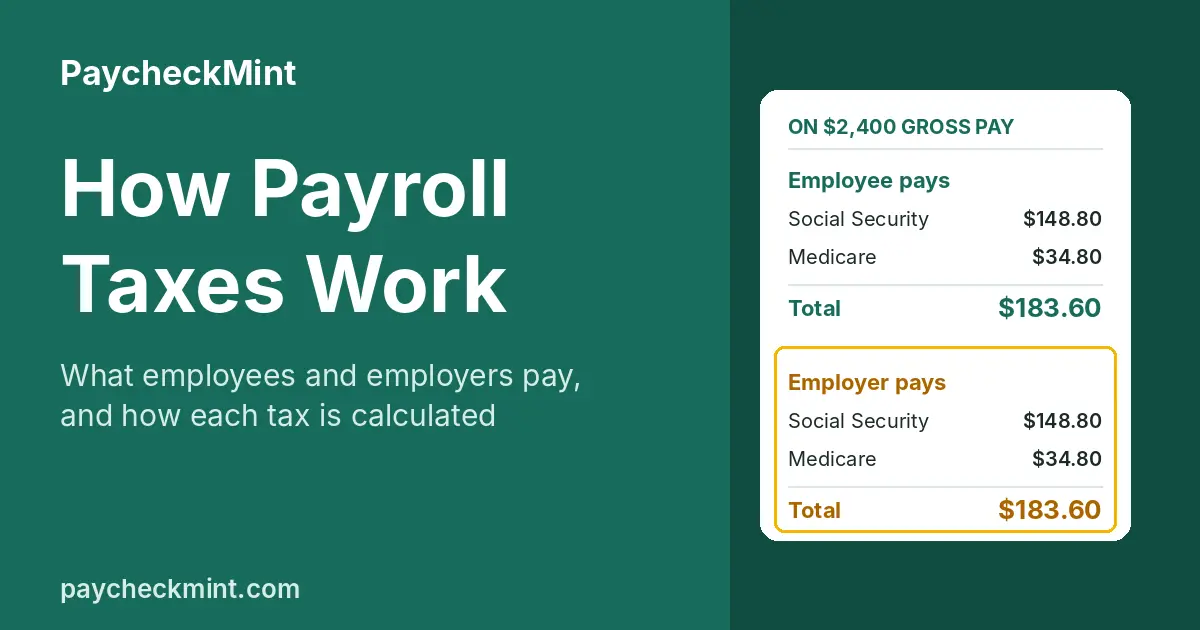
| Social Security (6.2%) | -$148.80 | +$148.80 |
| Medicare (1.45%) | -$34.80 | +$34.80 |
| Federal income tax (illustrative) | -$220.00 | n/a |
| State income tax (illustrative) | -$80.00 | n/a |
| Result | Take-home: $1,916.40 | Wages plus matching FICA: $2,583.60 |
The employer also pays FUTA and SUTA on the first part of the year's wages, so the real cost of this employee is higher than $2,583.60 per paycheck early in the year.
Tip: Take-home pay here is $2,400 minus $148.80, $34.80, $220 and $80, which is $1,916.40. Your own number will differ if you have benefits or retirement contributions.
What employers must file and deposit
Employers withhold the taxes from pay and then deposit them with the government on a schedule. The details depend on the size of your tax liability, so confirm the current rules with the IRS and your state.
- Deposits: federal payroll taxes are deposited monthly or semiweekly, depending on your lookback-period liability.
- Form 941: reported each quarter, covering income tax withholding and FICA.
- Form 940: reported annually for FUTA.
- Form W-2: given to each employee and filed with the Social Security Administration, generally by January 31.
- State filings: unemployment tax reports and withholding returns, with their own due dates.
Common payroll tax mistakes
- Misclassifying employees as contractors, which can lead to back taxes and penalties.
- Depositing late, even when the amount is right.
- Using outdated withholding tables or wage limits after the new year.
- Withholding for the wrong state when staff work remotely or across state lines.
- Treating pre-tax deductions incorrectly, so taxable wages are overstated or understated.
Self-employed payroll tax
If you work for yourself, you pay both halves of Social Security and Medicare as self-employment tax, which is 15.3% on most net earnings (12.4% Social Security plus 2.9% Medicare), subject to the same wage base for the Social Security part. You can deduct half of it when calculating income tax. Self-employed people usually pay through quarterly estimated taxes instead of paycheck withholding.
Estimate your payroll taxes
Enter your pay, filing status and state to see federal tax, FICA and take-home pay.
Open the paycheck tax calculatorFrequently asked questions
What are payroll taxes?
Payroll taxes are taxes tied to wages. They include federal income tax withholding, Social Security and Medicare (FICA) taxes, federal and state unemployment taxes, and any state or local payroll programs. Some are withheld from the employee's pay and some are paid by the employer.
Who pays payroll taxes, the employee or the employer?
Both. Employees pay federal income tax (through withholding), their half of Social Security and Medicare, and any state income tax. Employers match Social Security and Medicare and also pay federal and state unemployment taxes.
Is payroll tax the same as income tax?
No. Income tax withholding is an advance payment toward your annual income tax bill. Payroll taxes usually refers to Social Security, Medicare and unemployment taxes, which fund specific programs, and the term is also used for the whole set of taxes processed through payroll.
How much do employers pay in payroll taxes?
On most wages an employer pays 7.65% (6.2% Social Security plus 1.45% Medicare) on top of gross pay, plus federal unemployment tax (up to $42 per employee per year for most employers) and state unemployment tax, which varies by state and employer.
Are payroll taxes taken out of every paycheck?
Yes, in general. Social Security, Medicare and income tax withholding are calculated each pay period. Social Security stops after your wages pass the yearly wage base, and unemployment taxes stop after the yearly wage limit is reached.
This article is for general information only and is not tax, legal or payroll advice. Tax rates, wage bases, deposit rules and filing deadlines change and vary by state. Confirm current requirements with the IRS, your state agency or a qualified professional.